What changes about doing laundry in a passive house?
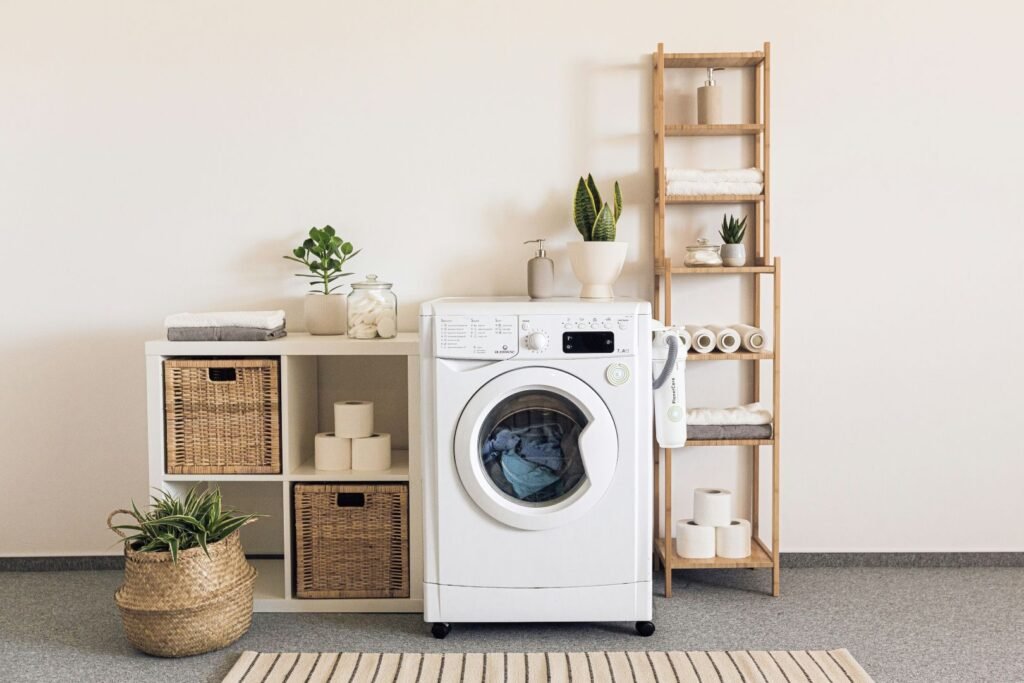
Laundry is one of those household tasks that most people don't think about until something makes it inconvenient. In a passive house, a few things about how you do laundry change, some for the better, one or two requiring a small adjustment in habit. None of it is complicated, but understanding what's different and why helps you get the most out of the home from day one.
Drying your clothes
The biggest practical change for most passive house owners is how and where laundry is dried. In a conventional home, you can hang wet laundry inside – particularly in winter or on rainy days. The building's natural leakiness allows the resulting moisture to escape through the fabric without much consequence.
In a passive house design, drying laundry indoors on racks or airers introduces a significant moisture load into a tightly sealed building. That moisture has nowhere to go except into the air, and while the mechanical ventilation with heat recovery (MVHR) system continuously manages humidity throughout the home, a large load of wet laundry drying in a living room or bedroom can push indoor humidity levels higher than the system is designed to handle as a matter of routine.
This doesn’t mean you can never dry laundry inside a passive house. It just means you need to think about where and how. A dedicated drying room or laundry space with its own extract ventilation is the most effective solution, and it’s worth discussing with your passive house designers in Australia at the design stage if indoor drying is part of your household’s normal
routine. Some passive house designs in Australia include a purpose-designed drying room,
recognising that it’s one of the most practical indoor moisture management
challenges for Australian households.
If you want to include a mechanical drying option, a heat pump clothes dryer is the most compatible solution for a passive house. Unlike a conventional vented dryer – which exhausts warm, moist air to the outside through a duct that needs to be carefully detailed for airtightness
– a heat pump dryer is a closed-loop system that condenses moisture from the clothes into a reservoir rather than venting it to the outside. It uses less energy than a conventional dryer, produces no moisture load on the indoor air and requires no penetration
through the building envelope.
Washing machines and water temperature
Washing machines in a passive house work exactly as they do in any other home. There's
no specific adjustment needed for the machine itself. The main consideration is water
temperature. Most modern washing machines heat their own water internally, which means
the heat generated during a wash cycle contributes to the home's internal heat gains – a small but considerable addition to the thermal balance that passive house energy modelling accounts for alongside other appliances.
Laundry placement and ventilation
Where the laundry is located within the floor plan of a passive house design is more
important than it would be in a conventional home. A laundry generates humidity from both
the washing machine and any drying that takes place there, and that humidity needs to be
extracted effectively before it migrates into the rest of the home.
In a passive house, the laundry is typically included in the MVHR extract zoning. Stale, moist
air is drawn out of the laundry continuously, just as it is from bathrooms and the kitchen. This
is effective for managing background humidity from the washing machine, but a laundry
that's also used for indoor drying may need a higher extract rate or a dedicated boost
function to handle the additional moisture load.
Positioning the laundry adjacent to a bathroom or wet area, where the MVHR extract infrastructure is already concentrated, is a practical design choice that simplifies the ventilation layout and ensures the laundry's moisture load is managed effectively without requiring a separate duct run across the building.
Outdoor drying
For passive house designs in Australia, where sunshine is reliable for most of the year in
most areas, outdoor drying on a clothesline or retractable rack is both practical and consistent with the home's low-energy ethos. The main design consideration is ensuring that
the outdoor drying area is accessible from the laundry without requiring occupants to carry wet laundry through the main living areas.
Frequently Asked Questions
Yes, but it needs to be managed carefully. Wet laundry introduces a significant moisture load
into an airtight home, and doing it regularly in living areas can push humidity above comfortable levels. A dedicated laundry or drying room with good extract ventilation is the best solution. A heat pump dryer is the most practical alternative as it condenses moisture into a reservoir rather than releasing it into the air.
No, any standard washing machine works fine. The main consideration is that the laundry space needs good extract ventilation to manage the background humidity from washing cycles, and if you're planning to dry clothes indoors, a dedicated space with higher extract
capacity can be built into the passive house design from the start.
In most Australian climates, yes. Outdoor drying is free, requires no energy and adds no moisture to the indoor air. It's also the simplest option from a passive house perspective, as it requires no envelope penetrations and no additional ventilation. For days when outdoor drying isn't practical, a heat pump dryer is the next best option for a passive house design in Australia.