How passive house windows are different from standard double glazing
Why windows matter so much in passive house design
Windows are the weakest point in any building envelope. Even a well-insulated wall loses relatively little heat compared to a poorly performing window of the same area. In a passive house design, where the building envelope is optimised to minimise heat loss in winter and heat gain in summer, windows need to perform at a level that standard double glazing simply doesn’t reach.
A standard double-glazed window might have a U-value – a measure of heat transmission – of around 2.8 watts per square metre per Kelvin. A window in a passive house in Australia typically achieves a U-value of 0.8 or below. That’s more than three times better thermal performance from a component that, in a typical home, accounts for a significant proportion of total heat loss.
Triple glazing – but not only triple glazing
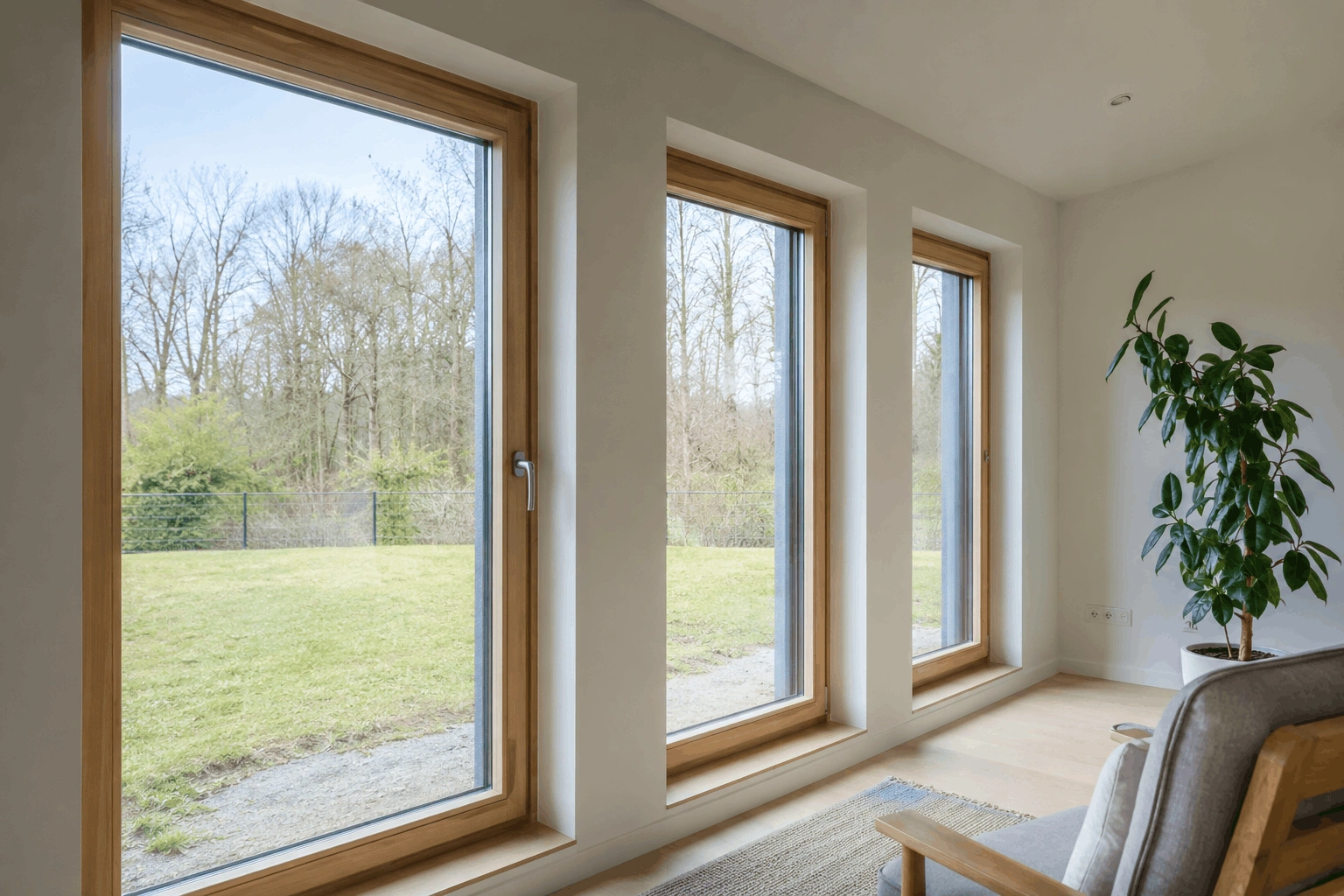
The most visible difference between a passive house window and a standard double-glazed unit is the number of panes. Passive house windows are almost always triple-glazed, using three panes of glass separated by two insulating cavities. But triple glazing alone doesn’t make a passive house window. The performance gains come from a combination of features working together.
The cavities between the panes are filled with an inert gas – typically argon or krypton – rather than air. These gases conduct heat less readily than air, reducing the rate at which heat transfers across the cavity. The glass itself is coated with a low-emissivity (low-e) coating that reflects long-wave infrared radiation back into the room rather than allowing it to pass through. And the spacer bar that separates the panes at the edge of the glass is made from a thermally broken material – typically a polymer composite rather than aluminium – to prevent the edge of the glass from becoming a thermal bridge.
Each of these features contributes to the overall performance of the window. Together, they produce a unit that behaves more like a well-insulated wall than a conventional window.
The frame matters as much as the glass
Window performance isn’t determined by the glass alone. The frame – the structural element that holds the glass and connects the window to the wall – is a significant thermal pathway in its own right, and in a standard double-glazed window, it’s often the weakest link.
Aluminium frames, common in conventional Australian construction, are thermally conductive. Heat moves through them readily, creating cold surfaces on the interior face of the frame in winter and contributing to condensation risk. Passive house designs in Australia use frames made from thermally broken aluminium, uPVC, fibreglass or timber – all of which offer significantly better thermal performance than standard aluminium. The frame U-value is modelled separately from the glass U-value in PHPP – the energy modelling software that underpins every certified passive house design – and the overall window U-value, which combines glass and frame performance, is what determines whether a window meets passive house certification requirements.
Solar heat gain and the Australian context
Thermal insulation is only one dimension of window performance. The other is solar heat gain, which is the amount of solar energy that passes through the glass into the interior. In a cold climate, solar heat gain is desirable in winter as it reduces heating demand by allowing the sun to warm the interior directly. In a hot climate, solar heat gain is a problem as it drives cooling loads upward and can cause overheating.
This is where Australian conditions differ from the European context in which the passive house standard was developed. In cooler Australian locations, a higher solar heat gain coefficient (SHGC) on north-facing windows is beneficial, allowing winter sun to contribute to space heating. In hot-climate locations like tropical Queensland, Darwin and inland New South Wales, a lower SHGC is preferable, reducing the solar load on the building’s cooling system.
Passive house designers in Australia use PHPP modelling to specify the right combination of U-value and SHGC for each window in each orientation, based on the specific climate zone of the project. This level of specification is not something that standard double glazing – typically specified to a single performance tier regardless of orientation or climate – can match.
Cost and availability in Australia
Passive house-certified windows are more expensive than standard double glazing – a premium that reflects the additional materials, manufacturing precision and testing required to achieve certified performance levels. In Australia, the market for these windows has developed significantly over the past decade, with European manufacturers now well represented through local distributors and a small number of Australian manufacturers producing windows to passive house performance levels.
While more expensive, windows specified to the passive house standard are typically a one-time investment in a component that will be in place for the life of the building, around 30 to 50 years. The energy savings from superior window performance accumulate every year across that lifetime, and the comfort improvement – elimination of cold radiant surfaces in winter, reduced glare and solar load in summer – is felt every day.
For anyone working with passive house builders on a new home, the window specification is one of the most consequential decisions in the design process. Getting it right, in collaboration with passive house designers in Australia who understand the climate-specific performance requirements for your location, is worth the additional time and cost.