What is a heat pump hot water system and why do passive houses use them?
Hot water is one of the largest energy loads in an Australian home. It’s also one of the least glamorous, and most people don’t think about it until the hot water runs out or the bill arrives. But in a passive house design, hot water is a deliberate design decision rather than an afterthought, and the heat pump hot water system is almost always the answer.
What does a heat pump water system do?
A heat pump hot water system works on the same principle as a reverse cycle air conditioner, but instead of heating or cooling a room, it heats water. It extracts heat energy from the surrounding air and transfers it into a storage tank, using a refrigerant cycle to amplify that heat to the temperature needed for household hot water.
The main difference from a conventional electric hot water system is efficiency. A standard electric storage hot water system uses a resistive element to heat water directly, typically on a basis of one unit of electricity in, one unit of heat out. A heat pump hot water system usually delivers two to three units of heat for every unit of electricity it consumes, because most of the energy it delivers comes from the ambient air rather than from the electricity itself. This ratio is called the coefficient of performance, or COP, and it’s what makes heat pump hot water systems so well suited to passive house designs in Australia.
Does a heat pump work with rooftop solar?
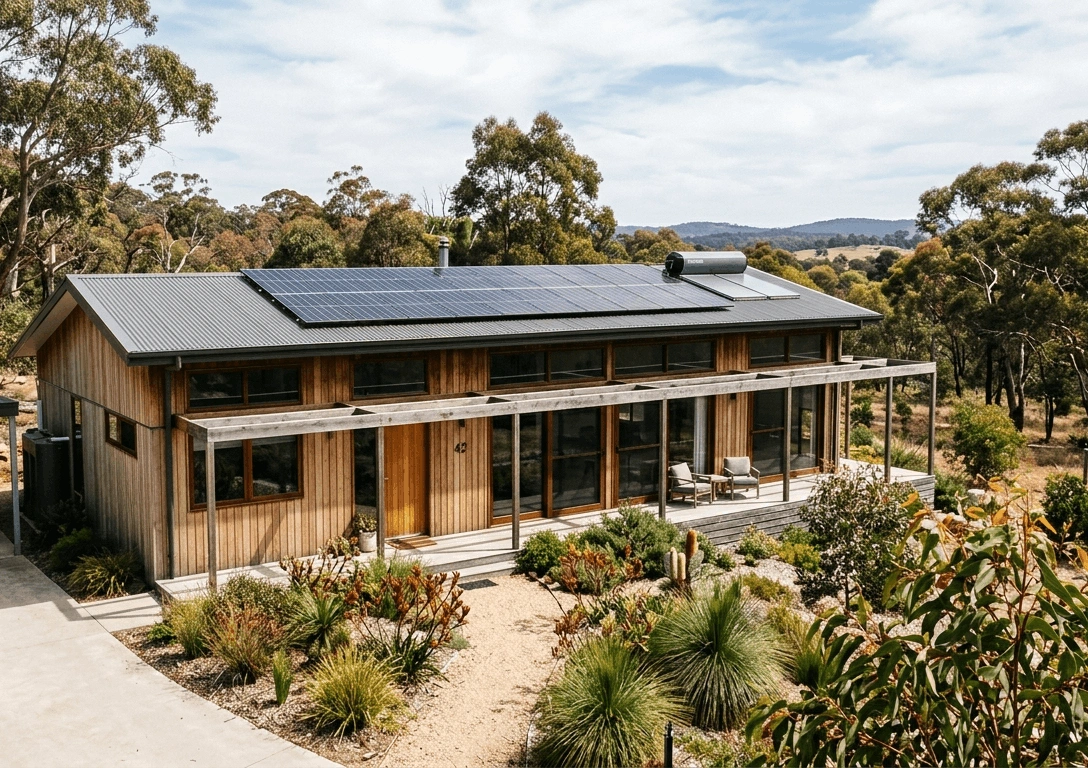
The combination of a heat pump hot water system and rooftop solar is one of the most effective energy management strategies available to passive houses in Australia. Hot water heating is a large, schedulable load – unlike lighting or appliances, which are used on demand, a hot water system can be programmed to heat during specific hours of the day.
Setting the heat pump to run during peak solar generation hours means the hot water tank is charged largely or entirely by solar energy rather than grid electricity. The insulated tank stores that energy as hot water until it’s needed. For many passive house designs in Australia, this approach reduces the net cost of hot water to near zero across much of the year.
Placement and the passive house envelope
Where you install a heat pump hot water system requires more thought in a passive house than in a conventional home. Heat pump systems extract heat from the surrounding air, which slightly cools the space they’re located in. In an outdoor location or an unheated garage, this cooling effect is irrelevant. Inside the conditioned building envelope, it can create a small additional heating load that needs to be accounted for in the energy modelling.
For most passive house designs, locating the heat pump hot water system in a garage, carport or purpose-designed external enclosure is the simplest approach. Where internal placement is unavoidable, experienced passive house designers in Australia will factor the cooling effect into the PHPP model and ensure the ventilation strategy for that space is appropriate.
The hot water tank itself also needs to penetrate the building envelope for pipe connections, and those penetrations need to be properly detailed for airtightness. This is standard practice for passive house builders in Australia, but it’s worth confirming with any builder unfamiliar with the standard.
Sizing the system correctly
Heat pump hot water systems need to be sized for the household’s actual daily hot water demand, the climate zone and the available solar generation window. An undersized system runs continuously and loses the efficiency advantage of solar-timed operation. An oversized one adds unnecessary upfront cost.
In a passive house, this sizing is part of the integrated design and modelling process rather than a separate purchasing decision. Passive house builders in Australia with experience in heat pump hot water specification will be familiar with the products available locally, their performance in different Australian climate zones and how to configure them for optimal solar integration.
What happens in cold climates?
Heat pump hot water systems extract heat from the ambient air, which means their efficiency varies with air temperature. In colder-climate Australian locations like Canberra, alpine Victoria or the southern tablelands, the coefficient of performance (COP), which measures how many units of heat the system delivers per unit of electricity consumed, drops on the coldest days. Some units also switch to a resistive backup element when ambient temperatures fall below a threshold, typically around 5 to 10 degrees Celsius, depending on the model.
This doesn’t mean you shouldn’t use a heat pump hot water system in cold climates. The system is still more efficient than a conventional electric system across most operating hours. But it might affect the general specifications of the system you opt to install. Passive house designers in Australia working in colder climate zones will select units rated for low ambient temperature performance rather than systems optimised for warmer conditions.
Frequently Asked Questions
It extracts heat from the surrounding air and transfers it into a storage tank using a refrigerant cycle – the same principle as a reverse cycle air conditioner. Because most of the heat it delivers comes from ambient air rather than electricity, it typically produces two to three units of heat for every unit of electricity consumed, making it significantly more efficient than a conventional electric storage system.
Not strictly, but it is standard practice in passive house designs in Australia for good reason. It's the most efficient way to heat water with electricity, and passive house designs are all-electric by nature. A less efficient hot water system in a passive house is leaving one of the most straightforward energy savings unused.
Yes, and this is one of the most effective ways to use it. Setting the system to heat during peak solar generation hours means the tank is charged largely by solar energy and stored until needed. For many passive house homeowners, this reduces the net cost of hot water to near zero across much of the year.