Understanding mechanical ventilation with heat recovery (MVHR) vs energy recovery ventilation (ERV)
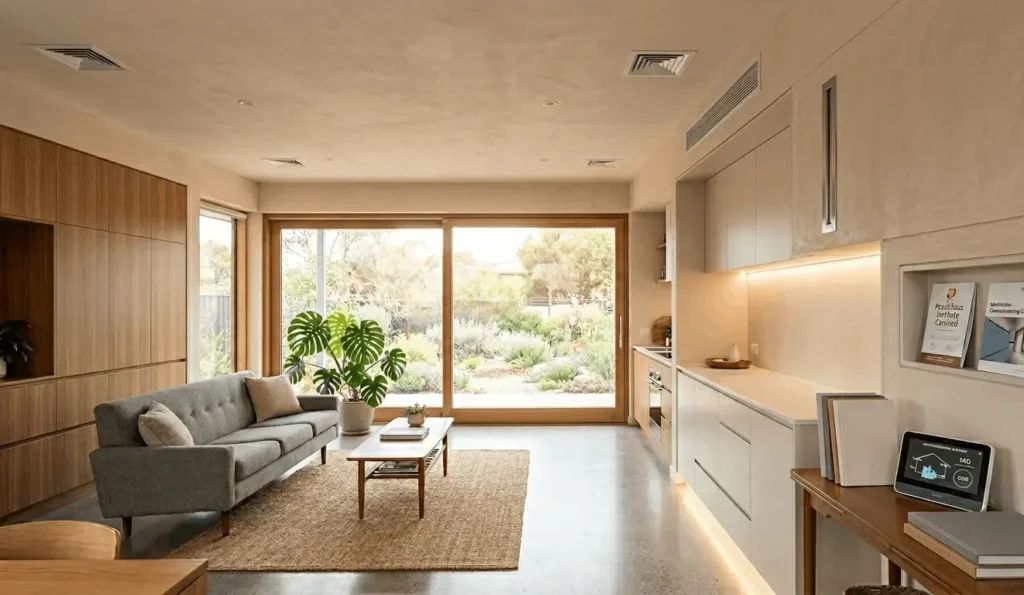
Seal a home as tightly as a passive house design demands and you immediately create a problem: where does the fresh air come from? The answer is mechanical ventilation with heat recovery (MVHR), and it’s one of the systems that makes passive house designs in Australia feel as comfortable as they do energy efficient.
But spend time researching units and you’ll quickly run into another acronym: ERV. It appears in product specs, certification documents and conversations with passive house builders. Understanding what it is and how it differs from MVHR will help you have a much more informed conversation with your design team.
What does MVHR actually mean?
MVHR describes a system that simultaneously supplies fresh air to living areas and extracts stale air from wet rooms, while recovering the energy from the outgoing air stream to condition the incoming one.
In winter, warm stale air leaving the home pre-heats the cold fresh air coming in. In summer, cool air leaving the home pre-cools the hot incoming air. The two air streams never mix – only energy transfers across a core inside the unit. The result is continuous fresh air throughout the home with very little energy penalty.
This is the standard ventilation solution in passive house designs in Australia, and it’s central to how a passive house maintains excellent indoor air quality without undermining its energy performance.
What does an ERV do differently?
An ERV does everything an MVHR does, but its core is also permeable to water vapour, meaning it transfers moisture between the two air streams as well as heat. In Australia, you’ll sometimes hear these referred to as enthalpy exchangers or membrane-core units rather than ERVs, depending on which supplier or builder you’re talking to.
This moisture transfer can either reduce incoming humidity or retain indoor moisture, depending on the climate and season.
Understanding that distinction – heat only versus heat and moisture – is the key to choosing the right system for your home.
Which one suits your climate?
In cool to cold climates – the ACT, alpine Victoria or elevated parts of New South Wales – a standard MVHR is usually the right choice. These climates tend to have manageable ambient humidity, and the priority is temperature recovery. An ERV in a very cold climate can contribute to higher indoor humidity levels in winter, which needs to be carefully managed. In colder climates, MVHR systems may also require defrost strategies, which are factored into system design and modelling.
In hot and humid climates – tropical Queensland, Darwin or coastal parts of the Northern Territory – an ERV or enthalpy-core unit is generally preferred. The challenge here isn’t just heat but the significant moisture load coming from outside. An ERV helps manage that before it enters the conditioned space, reducing the burden on any supplementary cooling.
In mixed or temperate climates – much of coastal New South Wales, Victoria and South Australia – the answer is less straightforward. Your passive building design team will use PHPP modelling to compare system performance based on climate, humidity and occupancy assumptions, helping determine which system delivers better results for your specific site.
How these systems fit into passive house certification
Both MVHR and ERV units can meet the ventilation requirements for a certified passive house in Australia, provided they achieve a sufficiently high heat recovery efficiency – typically 75% or above, though many high-performance units reach 85% to 90% and beyond.
For passive house certification, the ventilation system’s efficiency feeds directly into the primary energy calculation. Choosing a higher-efficiency unit can improve the building’s primary energy performance and help meet certification targets. Experienced passive home building teams will have hands-on knowledge of the units available locally, including how they perform in real conditions, how they’re commissioned and how filters and cores are maintained over time.
What to ask your builder or designer
When you’re talking to passive house builders about ventilation, a few questions are worth asking. What system are they recommending, and why? How is the ducting designed to minimise pressure drops? And how does the unit need to be maintained once you’re living in the home?
The ventilation system in a passive house design is integral to the performance of the whole building, and the right choice depends on where you’re building, how the home is designed and how your household actually lives in it.
Frequently Asked Questions
Not always. In cool to cold climates, a standard MVHR is usually the better choice, as an ERV can retain too much moisture inside the building during winter, which creates its own problems. In hot and humid climates, the moisture transfer an ERV provides is useful. Your passive house designer in Australia will model both options in PHPP to determine which performs better for your specific location.
Yes. Retrofitting is possible but requires careful planning around duct routes, airtightness improvements and ceiling or wall penetrations. If you're working towards EnerPHit standard on an existing home, your passive house builders in Australia will assess whether your current airtightness level justifies a full MVHR installation.
Both systems require regular filter changes, typically every three to six months, depending on the unit and your local air quality. The heat exchange core itself needs occasional cleaning, usually once a year. Compared to a ducted air conditioning system, the maintenance burden is relatively low. These units are designed to run continuously at low speed as background infrastructure rather than being switched on and off like conventional heating and cooling equipment.