How to find a certified passive house builder in Australia
Finding someone to build your home is one of the most important decisions you’ll make in the entire process. Finding someone to build a certified passive home raises the stakes further. The skills, knowledge and attention to detail required go well beyond standard residential construction. Most importantly, not every builder who uses the words “passive house” on their website has the credentials to back it up.
Here’s what to look for.
Start with certification
Certification means the builder has completed formal training through the Passive House Institute or a recognised equivalent and has demonstrated the knowledge required to deliver a building that meets the standard.
The most reliable starting point is the Australian Passive House Association. They maintain a directory of certified passive house builders Australia-wide, along with other professionals, including designers, consultants and assessors.
You need a certified builder because passive building design is not simply a philosophy or a general approach to energy efficiency. It is a precise technical standard with measurable performance targets that have to be met and independently verified. A builder without formal training may have good intentions and even some relevant experience, but the gap between good practice and certified performance can be significant, and it can show up after you’ve moved in.
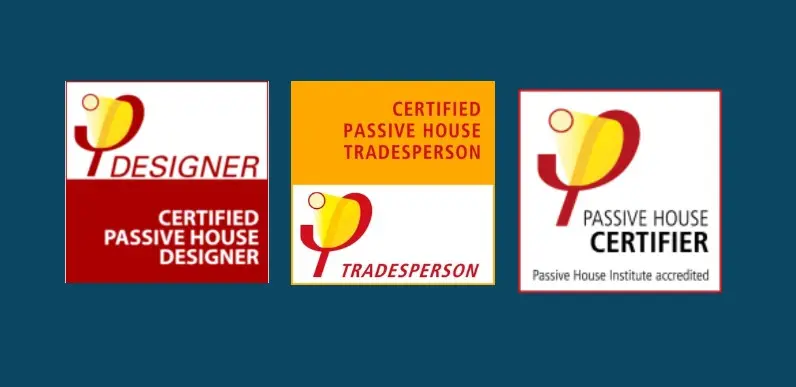
When searching for passive house builders, look specifically for those who hold Certified Passive House Tradesperson or Certified Passive House Builder status. These are the credentials that indicate hands-on construction competence, not just design familiarity. You might also look for Passivhaus, as the spelling differs sometimes.
Look for completed projects
Credentials on paper are one thing but completed buildings are another. Any builder worth considering should be able to point you to finished passive houses that have passed independent airtightness testing. This is the blower door test that every certified passive home must pass before certification is granted.
Ask to see the test results. A certified passive house in Australia will have documented evidence of its airtightness performance. If a builder can’t produce this, or becomes vague when you ask about it, that tells you something important.
Better still, ask whether you can speak with past clients. Passive house designers and builders in Australia who are confident in their work will generally welcome this. A conversation with someone who has already been through the process – from design to construction to living in the finished home – will give you a clearer picture than any website or brochure.
Know the difference between design and construction
One of the more common points of confusion when researching passive house design in Australia is the difference between a passive house designer and a passive house builder. These are separate roles and separate sets of credentials, though some firms offer both.
A passive house design is developed by an architect or designer with passive house training. They use specialist software to model the building’s thermal performance and produce a specification that, if built correctly, will meet the standard. The builder’s job is to execute that specification with the precision it requires – sealing the envelope correctly, installing windows to the right detail and ensuring every penetration through the building fabric is properly managed.
Both roles require specific knowledge. When designing a passive house, the energy modelling has to be accurate. When building one, the construction has to match the model.
In practice, passive house designers in Australia and builders tend to work much more closely together than is typical in standard residential construction. The nature of the standard demands it. Decisions made at the design stage have direct consequences on site, and issues that arise during construction often need to feed back into the model. That kind of ongoing communication between designer and builder is part of how a certified outcome is achieved.
Good results often come from established teams who have been through the process together before, speak the same technical language and trust each other’s judgement when problems need to be resolved quickly on site.
Ask the right questions
When you meet with a potential builder, the conversation itself will tell you a lot. A builder with genuine passive house experience will talk naturally about airtightness targets, heat recovery ventilation, thermal bridging and the importance of getting details right at junctions and penetrations. These are the things that determine whether a passive design house performs as designed or falls short.
Some useful questions to ask:
- How many certified passive homes have you completed?
- Can you share blower door test results from previous projects?
- Who do you work with on the passive house design and modelling?
- How do you manage subcontractors and trades on a passive house site?
- What happens if the airtightness test reveals a problem?
That last question is particularly revealing. A builder who has done this before will have a clear answer. They’ll know where problems typically occur, how to find them and how to fix them before the building is signed off.
A certified passive home is also a team effort. The builder is central, but the outcome also depends on the quality of the tradespeople and suppliers involved at every stage. Waterproofers, framers, window installers and electricians all have to understand the requirements of the standard and execute their work accordingly. A single poorly sealed penetration or a window installed without the correct detail can compromise the airtightness of the entire envelope.
When evaluating passive house builders in Australia, ask how they manage their trades. Do their regular subcontractors have experience on passive house sites? Have they worked on certified projects before? A builder whose core trades understand what’s required and why is far less likely to run into problems at the airtightness test than one who is training new people on the job.
Suppliers matter too. The performance of a certified passive house design depends heavily on the quality of the components specified – windows, membranes, tapes, ventilation units and insulation products all have to meet the standard. Experienced passive house builders have established relationships with suppliers who stock the right products and understand how they need to be installed. That supply chain knowledge is not something a builder new to the standard will have developed yet, and it makes a practical difference to how smoothly a project runs.
Frequently Asked Questions
The Australian Passive House Association maintains a directory of certified passive house builders Australia-wide. This is the most reliable starting point. Look specifically for builders who hold Certified Passive House Tradesperson or Builder status rather than those who simply list passive house as a service they offer.
In theory, any builder can attempt to construct a building to the passive house standard. In practice, your house won’t be considered certified if it was not built by a certified passive house builder.
The timeline for a certified passive house design in Australia is generally similar to a high-quality custom home of the same size, though the design phase can take longer. The energy modelling, specification and detailing required before construction begins is more involved than a standard residential project.