The role of water efficiency in passive house design

Water efficiency is an essential consideration in passive houses in Australia. While passive house design primarily focuses on energy performance and thermal comfort, the principles of sustainability extend to water use.
Careful planning and smart systems help reduce water consumption, lower bills, and support a more environmentally responsible home.
Beyond energy efficiency
The Passive House standard concentrates on heating and cooling energy reduction through superior insulation, airtightness and ventilation. Water consumption doesn’t factor into official certification requirements.
However, passive house builders in Australia increasingly recognise that truly sustainable buildings should address all resource consumption. A home that uses minimal energy for heating but wastes water through inefficient fixtures or poor design falls short of comprehensive sustainability.
Additionally, using less water reduces the energy needed to heat it, which supports the overall passive building design strategy.
Efficient fixtures and fittings
- Aerated taps that maintain pressure while using less water
- Low-flow showerheads designed for a high-quality experience
- Dual-flush toilets with ultra-low water consumption
- Heat pump dishwashers and washing machines
Rainwater harvesting and greywater reuse
Rainwater harvesting is a valuable strategy for passive house design in certain parts of Australia. Collecting rainwater from roofs and storing it for garden irrigation, toilet flushing or laundry reduces reliance on mains water.
Greywater systems can also help. They reuse water from baths, showers and basins for non-potable uses. These systems can be integrated during passive home building or added to existing passive house designs.
Both approaches reduce water demand, cut energy use for water heating and support sustainable living. In passive houses in Australia, combining rainwater and greywater systems is particularly beneficial in regions prone to dry conditions.
Water-efficient landscaping
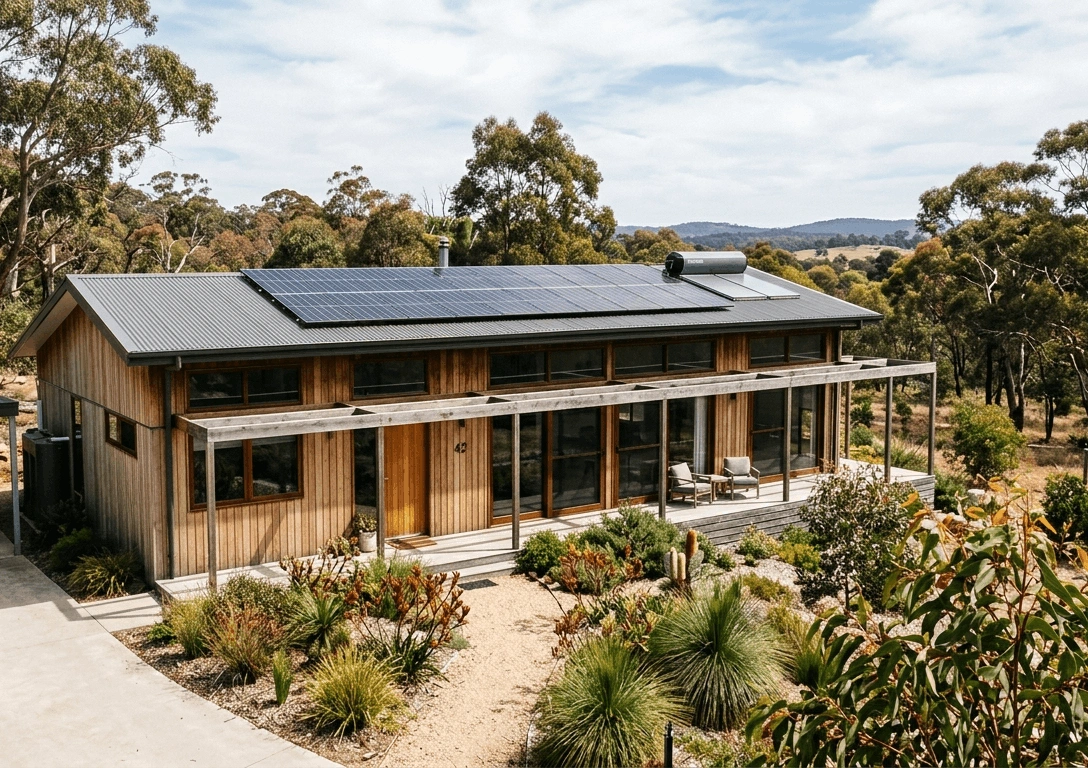
Water efficiency extends beyond the building itself. Landscaping choices can significantly reduce outdoor water use. Native and drought-tolerant landscaping reduces irrigation requirements dramatically. Many Australian native plants thrive with minimal supplementary watering once established.
Efficient irrigation systems using drip lines or subsurface methods deliver water directly to plant roots, minimising evaporation losses. Moisture sensors prevent irrigation during or after rain, avoiding unnecessary water use. These systems can be integrated with rainwater or greywater supplies to further reduce reliance on mains water.
Permeable paving and rain gardens manage stormwater whilst supporting vegetation. These features reduce runoff, improve water quality and create attractive outdoor spaces. Your passive house builder can coordinate these landscape elements with building drainage systems for integrated water management.
A well-planned landscape also complements passive building design principles by providing natural shading and cooling effects. In passive houses in Australia, careful landscaping should be designed from the earliest stages of planning a passive house.
Hot water system efficiency
Heating water is one of the largest energy demands in a home. Integrating efficient hot water systems is essential for passive home building projects that aim for high performance.
Options include solar hot water, heat pump systems and highly insulated tanks. These systems work in combination with other elements of a passive design house, reducing energy consumption while providing consistent comfort.
Smart controls can further improve efficiency, allowing water to be heated only when needed and reducing waste.
Monitoring and maintenance
Planning for future needs
When designing your passive house, consider the future water needs of your household. A growing family, changes in occupancy or additional landscaping may increase water demand. Planning for scalability ensures that systems remain effective without requiring costly retrofits.
Your passive house builder can also advise on sizing rainwater tanks, greywater systems and hot water storage to accommodate future changes.